Pie safes and jelly cupboards were pieces of furniture designed to be utilitarian. They were used not only for pies but also for breads, jellies and jams, and baked goods. They are of Germanic influence which started out in Pennsylvania, then worked their way into the valleys of Virginia, Shenandoah, and into the Midwest as in Ohio, Indiana, and Illinois.
Pie Safe with star and cross design
The earliest piece was the jelly cupboard or preserve or jam cupboard as it was named in various parts of the country. It usually had one or two doors and several shelves. It was designed to store jam and preserve jars along with crocks. Pie safes were made ten to twenty years later. They were made to keep mice and flies away from baked goods but still provide ventilation to prevent mold and spoilage. There are various different sizes, but traditionally one is used to seeing six punched tins in the front with a variety of designs, sometimes three punched tins on both sides. Mortise and tenon construction was used with dovetailed drawers if there was a drawer on the piece. Pine and poplar were common, but it is not unusual to find pie safes made of cherry and walnut. It all depended on the locality and the availability of the type of wood.
The cupboards of New England were made of wide vertical pine boards and sometimes painted but not always. A normal size would be six feet high, three feet wide, and one to one and a half feet deep. They were economically designed and made to be more useful than stylish.
Shaker pie safe at Skinner Auctions
Shaker cupboards were made of pine or maple in traditional Shaker style with the emphasis on simplicity. Many were designed to fit in particular spaces in communal houses. An antique Shaker cupboard or pie safe can sell for thousands of dollars. A Shaker pie safe made in the Mt. Lebanon Shaker Community of New York (1845-1860) with double doors, five shelves, original hardware, with screen panels replaced sold for $3,819 at Skinner's Auction in 2003.
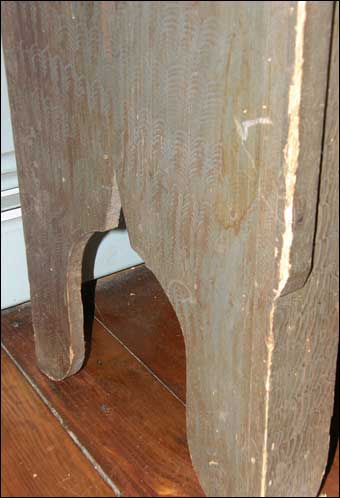
Details of the scrolled feet design
Details of the crown molding
Pennsylvania cupboards made by country cabinetmakers were usually five feet high, three feet wide with high legs and two doors. Sometimes there was a drawer on the top or bottom of the doors. Crown molding was typical. Some of the designs on the punched tin work were hearts, tulips, hex, and star designs. The type of wood could be either pine, poplar, cherry, or walnut.
If other types of wood were used or if the carvings were more elaborate, then the cupboard could have been made in the southern part of the United States. Many times brass hinges and porcelain knobs were used.
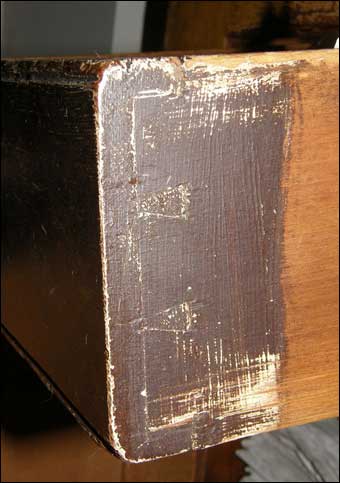
Normal wear around the dovetailed drawers
Details of normal wear around knob
It is not uncommon for jelly cupboards and pie safes to have signs of hard wear. Sometimes there is a mouse or rat hole found on the bottom or top of the piece. Softened and rounded edges on corners appear on softer woods. Stained circles can show on shelves from the preserve jars. Drawer frames and edges also show wear. Patina and normal hard wear add to the value of these pieces. The sought out cupboards and pie safes are either grain painted or have their original painted surface.
Antique Roadshow pie safe (2005)
If the pie safe has missing tins, it is still possible to fine old tins at an outdoor antique flea market, but don't expect to match the design of the tins already on the pie safe. Hardware can be replaced if it is missing. Hardware collectors always have an assortment of hardware to choose.
The value of these pieces of furniture continue to rise each year. On August 13, 2005, a 19th century Ohio-Indiana walnut pie safe, ca. 1860 was appraised at $5,000-$7,000 on the Antiques Roadshow in Los Angeles. Pie safes and jelly cupboards although unsophisticated when made still add to charm and storage space to kitchens, dining and living rooms.