Pittsburgh in 1817. The smoke from the columns on the right are probably Bakewell's glass house at the foot of Grant Street
It is thought that the first glass works west of the Allegheny Mountains was the Geneva Works built in 1787 by Albert Gallatin, Secretary of the Treasury to Thomas Jefferson. Although the year is in question. The Gallatin Glass Works was situated ninety miles south of Pittsburgh. However, through correspondence between Henry Adams, author of The Life of Albert Gallatin, Philadelphia 1879 and the descendants of Major Isaac Craig, the date that the Gallatin Glass Works started was 1797. Here is an excerpt from The Life of Albert Gallatin:
Congress rose on the 1st June, 1796, and Mr. and Mrs. Gallatin passed the summer in New York. Meanwhile, the co-partnership in which he had engaged had resulted in establishing on George's Creek a little settlement named New Geneva, and here were carried on various kinds of business, the most important and profitable of which was that of glass-making, begun during Mr. Gallatin's absence in the spring of 1797.
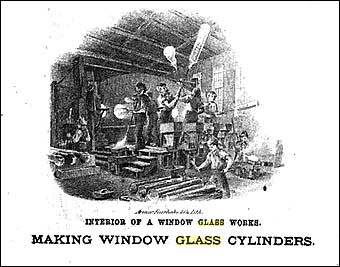
Making window glass cylinders
"The Proprietors of the Pittsburgh Glass Works, having procured a sufficient number of the most approved European Glass manufacturers and having on hand a large stock of the best materials, on which their workmen are now employed, have the pleasure of assuring the public, that window glass of superior quality and of any size from 7 X 9, to 8 X 24 inches, carefully packed in boxes containing 100 feet each, may be had at the shortest notice. Glass of large sizes, for other purposes may also be had, such as for pictures, coach glasses, clock faces, &. Bottles of all kinds of any quantity may also be had, together with pocket flasks, pickling jars, apothecary's shop furniture or other hollow ware the whole at least 25 per cent lower than articles of the same quality brought from any sea port in the United States. A liberal allowance will be made on sale of large quantities. Orders from merchants and others will be punctually attended to on application to JAMES O'HARA or ISAAC CRAIG or the Store of Prather & Smiley Market Street, Pittsburgh."Papers found after the death of Colonel O'Hara mentioned of their first bottle made at the glass house. In his handwriting, he wrote, "To-day we made the first bottle, at a cost of $30,000." Essentially their factory was a window glass factory which made some bottles.

Benjamin Bakewell
Edward Ensell, an English manufacturer of both window and flint glass in Birmingham, England, sold his glass works and came to this country for a better living. He teamed up with a carpenter, George Robinson in the fall of 1807. They began to erect a flint glass house in Pittsburgh. Mr. George Robinson, a carpenter by trade, and Mr. Edward Ensell, an English glassworker, who had been a manufacturer of both window and flint glass at Birmingham, England, and had sold his works and come to this country to better his condition, commenced the erection of a flint glass works at Pittsburgh. Both partners lacked capital and were unable to finish the works which was then offered for sale.

Billhead of Bakewell, Page and Bakewell, ca. 1815
The term "flint" does not mean that the glass is produced from flint. In the early days, powdered flint was often used as a source of silica. Instead flint indicates glass has a high lead content, such as that used for the manufacture of art glass and tableware. Bakewell with the first to make fully cut glass in America. Bakewell factory produced objects that reflected the highest quality of craftsmanship and decoration achieved in 19th-century American glass.

Pittsburgh Flint Glass Manufactory
In 1810, the firm engaged the "ingenious German" William Peter Eichbaum, former glass cutter to Louis XVI, late King of France, as a glass cutter. He was the first to make prisms for chandeliers and was the first to cut a crystal chandelier ever made in America. The chandelier was six light affair with prisms which was suspended in the house of Mr. Kerr, an innkeeper. Bakewell & Company took over the glass works in 1813 which was erected 1809 by George Robinson on Water Street above Grant and called the works the Pittsburgh Flint Glass Manufactory.

Bakewell Whale Oil Lamps which are blown, pressed, and engraved, 1820-1840 purchased by Corning Museum of Glass

Compote, decanter, and celery vase, Pittsburgh 1825-1840
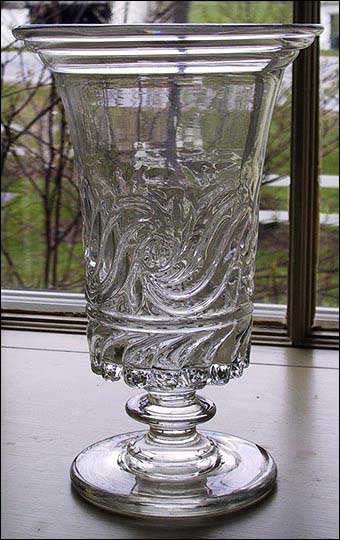
Blown Three Mold Celery Vase Pittsburgh from the Bakewell, Page & Bakewell Glass Works, 1820-1840

Sulphide furniture knob with Benjamin Franklin. 1826-1845

Bakewell, Pears & Co. ad
After having devoted the day on his arrival at Pittsburg to public ceremonies, the general wished to employ part of the next day in visiting some of the ingenious establishments which constitute the glory and prosperity of that manufacturing city, which, for the variety and excellence of its products, deserves to be compared to our Saint Etienne, or to Manchester in England. He was struck by the excellence and perfection of the processes employed in the various workshops which he examined; but that which interested him above all was the manufacture of glass, some patterns of which were presented to him, that, for their clearness and transparency, might have been admired even by the side of the glass of Baccarat.

One of the vases presented to Lafayette on his trip to Pittsburgh in May 1825. The vase sold at Christie's in Paris for $267,022. It is signed and dated on the base of the vase 'Bakewell Page Bakewells Pittsburgh 1825' or '1829.' The body of the vase was restored and has some chips, cracks and losses.
The pair of vases along with other souvenirs Lafayette received on his American tour were exhibited at the Chicago World's Fair in 1893. They were not seen again until 1934, the centennial of Lafayette's death. The exhibit was in Paris at the Musée de l'Orangerie. The provenance was from Lafayette where the pair of vases were kept at the castle of La Grange Bléneau, then to Clementine progeny Tower Maubourg Baroness Brigode, his granddaughter and then to the current owners.
The one vase appeared at its first auction on June 23 of this year at Christie's in Paris. The estimate was $6,700-$11,000. Instead one of Bakewells works of art in glass commanded a record price for Early American Glass and realized $267,022. There whereabouts of the other vase is unknown. There is rumor that it might be in the United States. Is it not fitting that Bakewell's vision and dedication along with workmanship of his highly skilled artisans in the glass manufacturing industry should command such record prices. Bakewell died at the age of 78 in February 1844. The obituary in the Pittsburgh Morning Post read, "To the prosperity of Pittsburgh, he essentially contributed. ...In him were combined the affability and courtesy of a perfect gentleman."

Signed on the bottom of the vase
********************
List of Bakewell Firm Names - 1808-1882
Bakewell & Ensell. 1808-1809. This firm in the fall of 1808, completed the works. It was composed of the firm of Robert Kinder & Co., represented by Thomas Kinder; Benjamin Page; Benjamin Bakewell; and Edward Ensell, who withdrew in 1809. "Bakewell & Ensell offer for sale complete assortment; Qt. and pint decanters, Qt., pt., 1/2pt. and gill tumblers, cream jugs, sugar basins, pocket flasks., salts, phials, &c., &c; also, coachee and harness complete, and pair of handsome bay horses.
"October 19,1808."Succeeding membership of the firm of Bakewell, Pears & Co. was; Benjamin Bakewell Campbell, admitted August 1, 1854, Benjamin Bakewell Jr., admittted August 1, 1859; retired August 1, 1877. Jacob W. Paul, admitted August 1, 1864; retired August 1, 1872. Thomas Clinton Pears, Benjamin Bakewell Pears and Harry P. Pears assumed the interest of their father, John P. Pears, deceased August 1, 1874.
Advertisement, The Commonwealth
B. Bakewell & Co. 1809-August 31, 1813. Composed of Benjamin Page, Benjamin Bakewell and the firm of Robert Kinder & Co., who withdrew March 31, 1811.
"The partnership heretofore existing between Robert Kinder & Co., Benjamin Page and Benjamin Bakewell, Glass Manufacturers, under the firms of B. Bakewell & Co. was dissolved on the 13th March last."
"The business will in future be carried on by B. Page and B. Bakewell, under the firm of the former partnership."
ROBERT KINDER & CO.
BENJAMIN PAGE
BENJAMIN BAKEWELL
"Pittsburgh, 27 May 1811."
Advertisement, Pittsburgh Gazette, May 31, 1811.
Bakewell, Page & Bakewell. September 1, 1813, to July 31, 1827. Composed of Benjamin Page, Benjamin Bakewell and Thomas Bakewell.
"Notice - B. Bakewell & Co., Flint Glass Manufacturers, Respectfully inform their friends and the public that, their term of partnership having this day expired, the business will in future be carried on by Benjamin Page, Benjamin Bakewell and Thomas Bakewell, under the firm of Bakewell, Page & Bakewell, By whom all outstanding accounts of the former firm will be settled.
BENJAMIN PAGE
BENJAMIN BAKEWELL
"Pittsburgh. August 31, 1813."
ad. The Mercury, Pittsburgh, Thursday, September 2, 1813.
Bakewell, Page & Bakewells. August 1, 1827, to July 31, 1832. Composed of Benjamin Page, Benjamin Bakewell, Thomas Bakewell and John Palmer Bakewell, admitted Aubust 1, 1827. Dissolved by the retirement of Benjamin Page, July 31, 1832.
Bakewells & Anderson, August 1, 1832, to June 30, 1836. Composed of Benjamin Bakewell, Thomas Bakewell, John Palmer Bakewell and Alexander M. Anderson.
Bakewells & Co, July 1, 1836, to July 31, 1842. Composed of Benjamin Bakewell, Thomas Bakewell and John Palmer Bakewell, who retired July 31, 1842, died November 17, 1842.
Bakewell & Pears. August 1, 1842, to July 31, 1844. Composed of Benjamin Bakewell, Thomas Bakewell and John Palmer Pears. Dissolved by the death of Benjamin Bakewell, February 19, 1844.
Bakewell, Pears & Co. August 1, 1844, to July 31, 1880. Composed of Thomas Bakewell, died March 30, 1866, interest ceased August 1, 1866; John Palmer Pears, died February 5, 1874, interest ceased August 1, 1874; Benjamin Page Bakewell, retired August 1, 1864.
The plant of the Pittsburgh Flint Glass Works was removed in 1854 to the site occupied by the Oliver Wire & Fence Company. Limited, bounded by Bingham street and the bank of the Monongahela River and Eighth and Ninth streets, South Side. In 1873 the warehouses of the firm were removed to the works, from Nos. 31 and 33 Wood street, in which locality, northwest corner of Wood street and Second avenue, they had been since 1840.
Bakewell, Pears & Co., Limited. 1880-1881. In 1880 this limited partnership was formed, but dissolved the next year, and the concern finally wound up. B.B. Campbell, chairman; Harry P. Pears, secretary.
Source: Text by Bryan Wright