Colonial Sense has brought to its readers a few Shaker items to build. The classic period of Shaker furniture started in the 1820's and ended approximately 1860. The furniture was the expression of a utilitarian and simplistic design. But who were these communal artisans who were inspired by the belief that their love of God should be expressed in their workmanship?
Shaker woman Eldress Anna
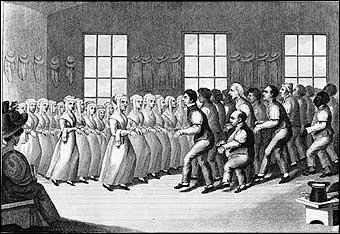
Did this way of life start out as a communal and celibate endeavor with equality between the sexes, or did it evolve over time? The colonial beginnings of the Shaker movement story does begin in the middle of the eighteenth century with a group of people moved so much by the Holy Spirit that they danced and their bodies shook or slithered on the floor during worship services. They were officially titled "The United Society of Believers in Christ's Second Appearance. Their charismatic leader was Mother Ann Lee who was acknowledged as "Mother of Christ" by the believers.
At the beginning of the nineteenth century, their membership totaled 1000. With the help of religious revivals which swept across America in the late eighteenth and early nineteenth centuries, the Shaker faith extended into Kentucky, Ohio, and Indiana bringing the total communities to eighteen. Between 1850 and 1860, the Shaker community experienced 6000 followers. Their holding were well over 50,000 acres with more than 1000 shops, homes, and farm buildings. They remain the oldest continuing communal group still extant with four members still known at Sabbathday Lake in New Gloucester, Maine as of 2006.
The simplicity, utility, and communal character of the Shaker furniture mirrored the philosophy of the Shaker people, The Baptist preacher, Joseph Meacham, who replaced James Wittaker upon his death in 1787 set the tone for Shaker work when he announced to his deacons that "all work done, or things made in the Church for their own use ought to be faithfully and well done, but plain and without superfluity." This belief extended into the Millenial Laws which were first issued in 1821, but the concept was expressed since the early Shaker period. These laws cautioned against manufacturing articles "which are superfluously wrought, and which have a tendency to feed the pride and the vanity of man, or such as would not be admissible to use among themselves, on account of their superfluity. "
There has been much literature published regarding the Shaker history. Colonial Sense wants to bring a controversial look at the sect called the Shakers. The author was William J. Haskett, the title of the book published in 1828 was called Shakerism Unmasked or The History of the Shakers. He was once a member of the Shaker community but became dissatisfied with the community and published his salacious book. In no other literature will you find the Shakers worshipping as "they danced naked, while, 'Mother Ann' went in among the men smiting - and dancing with them..." Was William J. Haskett so disillusioned with the Shaker practice of worshipping that it was his main goal to publish such a sensational book of rumors? We will let the readers be the judge by providing to you the book in Haskett's own words. End notes have been numeralized and added for easier reference.
Source: Introduction and transcription by Bryan Wright
Comments (2)
Comments (2)
kreiss 01/10/13
The article about the Shakers is especially interesting. Well done ! And I love the simplicity and careful workmanship of their furniture and household furnishings. Would enjoy seeing more samples of Shaker work here.
PGOster 01/10/13
The picture of "Mother Ann Lee" appears to be a photograph. Since she died in 1784, long before photography you should remove the picture or caption it for what ever it is. I believe that there is no paintings or drawings of her either.