

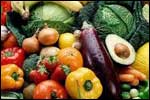
 Lettuce
 The Medeira white is best in market, esteemed softer flavored, and not so fiery, but the high red, round hard onions are the best; if you consult cheapness, the largest are best; if you consult taste and softness, the very smallest are the most delicate, and used at the first tables. Onions grow in the richest, highest cultivated ground, and better and better year after year, on the same ground. Properties of the Onion: The onion is possessed of a white, acrid, volatile oil, holding sulphur in solution, albumen, a good deal of uncrystallizable sugar and mucilage; phosphoric acid, both free and combined with lime; acetic acid, citrate of lime, and lignine. Of all the species of allium, the onion has the volatile principle in the greatest degree; and hence it is impossible to separate the scales of the root without the eyes being affected. The juice is sensibly acid, and is capable of being, by fermentation, converted into vinegar, and, mixed with water or the dregs of beer, yields, by distillation, an alcoholic liquor. Although used as a common esculent, onions are not suited to all stomachs; there are some who cannot eat them either fried or roasted, whilst others prefer them boiled, which is the best way of using them, as, by the process they then undergo, they are deprived of their essential oil. The pulp of roasted onions, with oil, forms an excellent anodyne and emollient poultice to suppurating tumours. Origin of the Onion: This vegetable is thought to have originally come from India, through Egypt, where it became an object of worship. Thence it was transmitted to Greece, thence to Italy, and ultimately it was distributed throughout Europe, in almost every part of which it has, from time immemorial, been cultivated. In warm climates it is found to be less acrid and much sweeter than in colder latitudes; and in Spain it is not at all unusual to see a peasant munching an onion, as an Englishman would an apple. Spanish onions, which are imported to this country during the winter months, are, when properly roasted, perfectly sweet, and equal to many preserves. History of the Onion: It is not supposed that any variety of the onion is indigenous to Britain, as when the large and mild roots imported from warmer climates, have been cultivated in these islands a few years, they deteriorate both in size and sweetness. It is therefore most likely that this plant was first introduced into England from continental Europe, and that it originally was produced in a southern climate, and has gradually become acclimatized to a colder atmosphere. |

Search |
| Comments (0) | Don't be shy, tell us what you think! → |
 |  |  |
Colonial Sense is an advocate for global consumer privacy rights, protection and security.
All material on this website © copyright 2009-26 by Colonial Sense, except where otherwise indicated.
ref:T5-S39-P936-C-M
All material on this website © copyright 2009-26 by Colonial Sense, except where otherwise indicated.
ref:T5-S39-P936-C-M