Overview
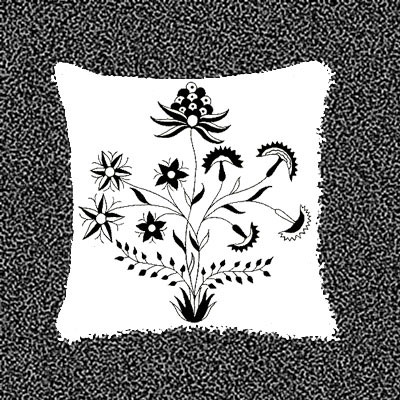
These are just a few of the many ways this one pattern can be designed and redesigned by you. Put it together any way you like. The combinations are as endless as your ability to restitch and reposition them.
Materials
Cream-colored linen (or linen-like fabric), 16 1/2" square
Carbon paper
Ball-point pen or No 2 pencil
Crewel thread (wool) in assorted colors
Matching or contrasting fabric (for back)
12" zipper
Cording (optional)
Directions
On all four edges of your fabric, run a machine stitch to prevent raveling. Trace the motifs onto a piece of plain paper. You may position the motif on the pillow according to your own taste.
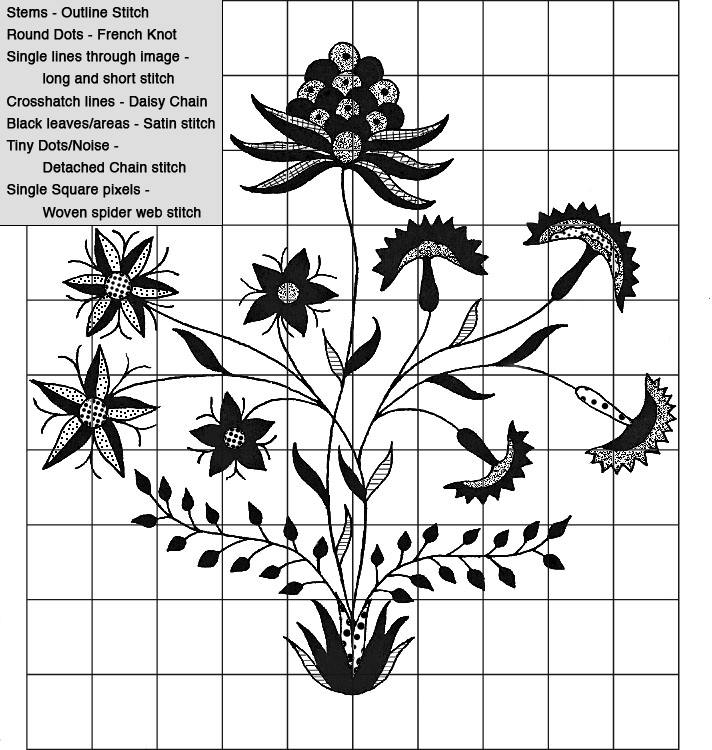
You can use a heat transfer pen which reverses the design. You can also use a sunny window. Pick any design you wish and place a piece of tracing paper over the design and trace the design with a felt tip pen. The tracing paper can be taken to the sunny window and taped. Make sure it is flat on all four sides. Take your material you are using and trace your design using the pen or pencil. Make sure the fabric doesn't shift. Work the motif, using an embroidery hoop. There are two parts to the hoop; the inner hoop and outer hoop. Loosen the screw connector on the outer hoop. Place the inner hoop on a flat service. Center your fabric over the inner hoop. Press the outer hoop down on the fabric over the inner hoop and tighten the screw. If you are doing a much larger design, you will have to come up with your own method for keeping the fabric taut. Replace pattern and carbon paper and trace another design. Do this until you have filled in as much of the pillow top or fabric as you wish.
There are no standards on the type of stitches to use. The common stitches they used long ago were chain, french knot, stem, long and short, feather, herringbone, satin, straight, and running. A wonderful source online is Sharon Boggins's online stitch dictionary- Dictionary of Stitches for Hand Embroidery and Needlework. A link to the website is located at the bottom of the article.
The last things to be done are the stems connecting the motifs. As you work, the motifs will become slightly askew from the pattern. This is only natural since the tension of the stitches tends to pull the fabric. Don't worry about it. By putting the stems on last, you will join all your elements together and the normal pull or give of the fabric won't make any difference. Just make sure your stems meet the motifs in the proper places.
After you have finished the embroidering, press your pillow top or fabric on the wrong side with a steam iron. If you have pulled the fabric out of shape, as you embroidered, this will square it off.
Pillow Back
For a 16" x 16" pillow, two pieces of fabric should be used (you may use the same fabric as the kind you used on the pillow top or, if you prefer, use contrasting silk, velvet, or upholstery fabric). One piece should be 16 inches wide and 6 1/2 inches deep, the other should be 16 1/2 inches wide and 12 1/4 inches deep. Insert a 12-inch zipper between the long sides of these two pieces.
For Knife-Edge Pillow
For a welt-edge pillow, cut a bias strip of matching or contrasting fabric 1 1/2 inches wide and 66 inches long, piecing on the bias where necessary. Fold in half lengthwise with the right sides out. Make sure it is over the piping cord. Machine stitch close to the cord, using a cording foot or zipper foot. With cut edges together baste welting to pillow front, easing around corners. Clip seam allowance of welting at corners to allow fullness to ease. With right sides together, center pillow top on back. Using cording or zipper foot, stitch top and back together as close to welting stitches as possible. Clip corners, turn. Insert pillow.
Another great source to download and copy a Jacobean gem pattern is listed below. Owen Davies lists Rules for Jacobean work, stitching methods, and colors used in each pattern.Source: Overview research & text by Shawn Wright; Making Pillows research & text by Bryan Wright