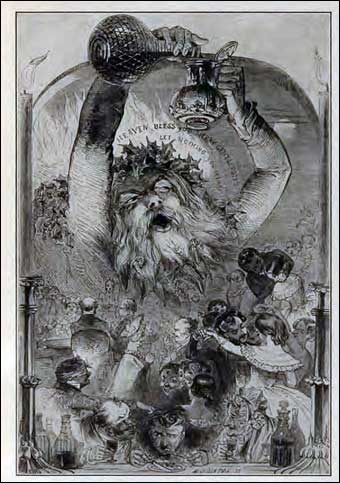
Father Christmas drawn in December 1847 by Kenny Meadows for the Illustrated London News.
Belsnickel was a Santa of the Palatinate in southwestern German along both sides of the Rhine who delivered shoes full of candy to children on the birthday of St. Nicholas, December 6 of each year. The stories of St. Nicholas has its roots going all the way back to the 3rd century. It is believed he was born between 260 and 280 AD in a place called Patara in Asia Minor, now Turkey. He spent most of his life in Lycia. St. Nicholas appeared in much of Europe for centuries.
It is legend in the Netherlands that St. Nicholas arrived by way of a steamboat from Spain two weeks before his birthday along with his companion Zwarte Piet (Black Peter) who helped St. Nicholas disperse gifts and candies to all the good children. If the children were bad, they could be taken back to Spain with St. Nicholas. It was said that St. Nicholas made Zwarte Piet carry a light birch rod to punish the bad children while he rode the city streets on a magnificent white horse.
The Northern German version of St. Nicholas was accompanied by Knecht Rupprecht, (Servant Ruprecht). He was dressed in skins or straw and was also known as Black Peter from the soot of the chimneys he goes down. Another nickname was ru-Klas or rough Nicholas. The Rhine province of Germany had slightly different companion with St. Nicholas. It was a boy by the name of Peltz Nickel who had a blackened face, a beard, and rattling chains. Peltz Nickel like an animal on all fours to represent the donkey the Christ child rode. The Christkind was represented by a little girl dressed in white. Peltz Nickel and Christkind went from home to home handing each mother a switch to discipline her children during the coming year. This was the beginnings of Kriss Kringle. When Pelz Nickel arrived at the children's homes, the children kindly said their prayers. They were rewarded with candy and honey cake or apples and nuts. The visiting began on the first Sunday in December and continued until Christmas Eve when St. Nicholas arrived with real Christmas gifts.

Title page of the most important Christmas book in the United States.

Painting by Ralph Dunkleberger for Christmas in Pennsylvania- A Folk-Cultural Study, Alfred L. Shoemaker.
The tradition of Belsnickel was carried to America wherever the Germans migrated. American Belsnickels usually wore masks and carried whips to frighten the children. Sometimes the Belsnickel wore a shaggy bearskin coat or skunk skin cap. This began the yearly tradition of Belsnickling in the rural and urban areas of Pennsylvania. It was not uncommon where a half dozen jovial men led by a Belsnickel burst into homes and tossed treats on the floor. Children who were rude would be lashed out with a whip. Such groups usually received refreshments or money as payment for their performance. This was more common with urban belsnickling. The rural belsnickeler worked alone while bringing nuts and candies to the homes.
Colonial Sense would like to bring to you back to those times with a few newspaper accounts accounts of the traditions of Belsnickling in the 19th and 20th century.

An ad printed in Lancaster, Pennsylvania in 1843 to introduce children to St. Nicholas.
Bellsnickel. This is a mischievous hobgoblin that makes his presence known to the people once a year by his cunning tricks of fairyism. Christmas is the time for his sporting revelry, and he then gives full scope to his permitted privileges in every shape that his roving imagination can suggest. Pottstown has had a full share of his presence this season if I am to judge from the wreck of lumber that is strewed through our streets and blockading the doors generally every morning, which indicates the work of a mighty marauder. A few mornings since a little before sunrise, as I was wending my way past your office, I beheld a complete bridge built across the street, principally composed of old barrels, hogsheads, grocery boxes, wheelbarrows, barrows, plows, wagon and cart wheels. It is reported that he nearly demolished a poor woman's house in one of the back streets a few nights ago. He performs these tricks incog, or otherwise he would be arrested long since by the public authorities, who are on the alert; but it will take a swift foot and a strong arm to apprehend him while he is in full power of his bellsnickelship, as he then can evade mortal ken. He has the appearance of a man of 50, and is about 4 feet high, red round face, curly black hair, with a long beard hanging perpendicular from his chin, and his upper lip finely graced with a pair of horned mustachios, of which a Turk would be proud; he is remarkably thick being made in a puncheon style, and is constantly laughing, which occasions his chunky frame to be in a perpetual shake; he carries a great budget on his back, filled with all the dainties common to the season-he cracks his nuts amongst the people as well as his jokes without their perceiving him. His antique clothing cannot pass unnoticed, as a description of its comical fashion may excite some ambition amongst the dandies, who are always on the look-out for something flashy and neat, beyond what an honest, industrious, plain mechanic wears, to correspondent their mode of dress with his, whose costume is entirely novel to the present generation; besides the French and English fashions are completely exhausted and have become obsolete; therefore, a description of his grotesque raiment I presume will be acceptable.
This genus of the night winds and storms is, when at a distance, entirely a nondescript; but when he approaches his uncouth magnitude diminishes, and you can accurately survey his puncheon frame from top to toe. His cap, a queer one indeed, is made out of a black bearskin, fringed round or rather stuck round with porcupine quills painted a fiery red, and having two folds at each side, with which he at pleasure covers his neck and part of his funny face, giving sufficient scope for his keen eye to penetrate on both sides when he is on his exploits of night-errantry. His outer garment, like Joseph's of old, is of many colors, made in the Adamitish mode, hanging straight down from his shoulders to his heels, with a tightening belt attached to the waist-the buttons seem to be manufactured entirely in an ancient style-out of the shells of hickory nuts, with an eye on whalebone ingeniously fixed in each,-when he runs, the tail of his long coat flies out behind which gives an opportunity to behold his little short red plush breeches, with brass kneebuckles attached to his extremities, the size of a full moon. His stockings are composed of green buckram, finely polished. His moccasins are the same as those worn by the Chippawa nation. He carries a bow with a sheaf of arrows thrown across his miscellaneous budget, thus equipt he sallies forth in the dark of night, with a few tinkling bells attached to his bearskin cap and the tail of his long coat, and makes as much noise as mischief through our town while the peaceable inhabitants are quietly reposing under the influence of Morpheus.
From the Easton Whig of December 24, 1851
The occasion [Christmas] is celebrated by all in ways too various to be mentioned; all, at the time however, contriving to make it the merriest part of the year. And the children! What a season for them! Such a planning, and talking, and conjecturing as there is among them on the eve of Christmas, and New Year especially. I was staying at a friend's house during the holidays of '46. The father purposed to the older ones of the family, that he should quote "Santa Claus," or "Bellsnickle," as the children termed him. Accordingly, they were sent to bed quite early in the evening. Nothing occurred to disturb their visions of overflowing stockings, trees bending beneath the burdens, and so on, until nearly daybreak, when they were startled by a loud knocking at the head of the staircase. Everyone was awakened by the noise, and the first impression was the "Bellsnickle." Hastily dressing themselves they met at the landing, when a consultation was held between them who should go down first. This was not so easily settled, and they proceeded to go down, carefully searching every corner for fear he might still be lurking in some secret place. Arriving in the parlor, each one proceeded to lay hold on what he considered his own, when a loud thumping in adjoining room sent them bounding upstairs in double quick time. Nor could they be prevailed upon to come down again until the sun was high in the heavens.
From the Harrisburg Patriot of December 25, 1876
The description of Momus-the fun and mischief loving portion of our population-were also "about" dressed in the costumes of "Beltznickels," clowns, harlequins, Indian chiefs, rag-a-muffins, girls of the period, negro performers, and in masquerade suits of every imaginable cut, shape, and color, making night hiedous [sic]with horn music, kettle-drums, trumpets, penny whistles, etc. This latter class were given all the license they needed to carry out the time-honored old custom of merry making on Christmas eve, and in not a single instance that came under our observation, were they molested or interfered with. At many private residences the masqueraders were invited to enter and receive Christmas "treats." The scene and the occasion revived memories of the past, when many of our old, substantial citizens were boys and did exactly the same thing. In point of numbers the harlequinade of Saturday night exceeded that of former years to a considerable extent. The streets had much the appearance of Venice on a carnival night and everybody and their friends appeared to enjoy the scene and the occasion.
From the York Sunday Gazette of December 24, 1905
The presence of a few youngsters on the street last evening playing "bellsnickle" recalled to the memories of the older persons how suddenly that harmless and once almost universal pastime on Christmas Eve has fallen into decay and without any apparent reason.Source: Text by Bryan Wright
There were more in evidence last night than for some years and some of them were gorgeous or ridiculous, as their tastes varied. But they were not the real old-fashioned kind. Groups of them attracted much attention on the streets. Most of them were children, but some were artistic and gave stunts that greatly amused. They reaped a harvest of pennies, nickels and dimes from the good-natured Christmas shoppers.
Less than a decade ago if from twenty-five to fifty "bellsnickles" did not visit the homes of each prosperous farmer, something was wrong and the owner of the fireside thought himself slighted and felt as if he had not lived at peace with his neighbors. It has all changed now. Not a real bellsnickle to be seen. A few boys occasionally "dress up" and visit a home or two, but they are not the bellsnickles of old and the amusement and fun of the past is dead.
A veteran of the three-score years variety commenting on the situation yesterday said:
"It is strange how suddenly the bellsnickle passed away when once it started to decline. It is less than twenty years ago when every musician in the country blackened up and joined a crowd to visit the homes for a good time on Christmas Eve. Now a person scarcely hears of a bellsnickle and in another decade the children will only know what bellsnickles were by reading about them. When I lived on a farm ten or fifteen years ago, each farmer's wife made great preparations for the coming of the bellsnickles. There was cake and mince pie and fastnachts, apples, hard cider and they were all dispensed with bounteous hand. The young fellows and even men of forty would blacken up, and with fiddles, jewsharps, mouth organs and banjos, make the rounds of the best homes in each neighborhood. They would play and sing and dance and after each set as they called it, the mince pie and cake and apples and hard cider would be passed around. The bellsnickles shined up to, and don't you forget it. No patent affair that was guaranteed not to harm the skin, but common stove black or shoe blackening was rubbed on the face and handds and then a brush was used until the face shone and until the bellsnickle had the real appearance of the darky minstrel. How did bellsnickling originate? Well that is a hard one, but it has been in vogue ever since I can remember-about 1845. I have often heard it said that is was following out a custom established in the south when slaves would appear before their masters on Christmas Eve and their dance and sing and play the banjo for the master and guests' entertainment and after each number the slaves would be treated to the best in the house, the one occasion of the year. And I guess that's how it originated. The bellsnickles of a generation ago were the country minstrels who were to carry good cheer and Christmas carols to the homes of the big farmers of the country and they in turn got the best the land could afford. Bellsnickling began to deteriorate about the time the present generation of young men began to bloom. They would not "blacken up" and they insisted on buying cheap black false faces. That never took, because one of the real ideas of bellsnickling was to "shine up" so that the bellsnickle would not be known even by his own friends and neighbors. With the coming of the false face the young ladies would make a descent on the owner of a false face and by the time the melee was over the false face had been torn to pieces and their was no bellsnickle. That I believe led to the decay of bellsnickling and the dispensing of good cheer on Christmas Eve to the country boys."